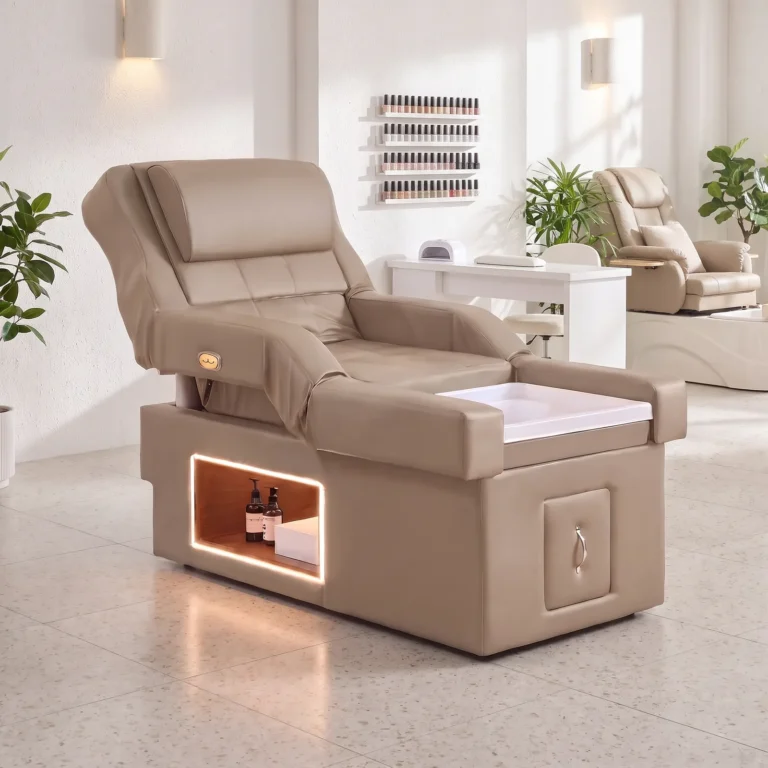
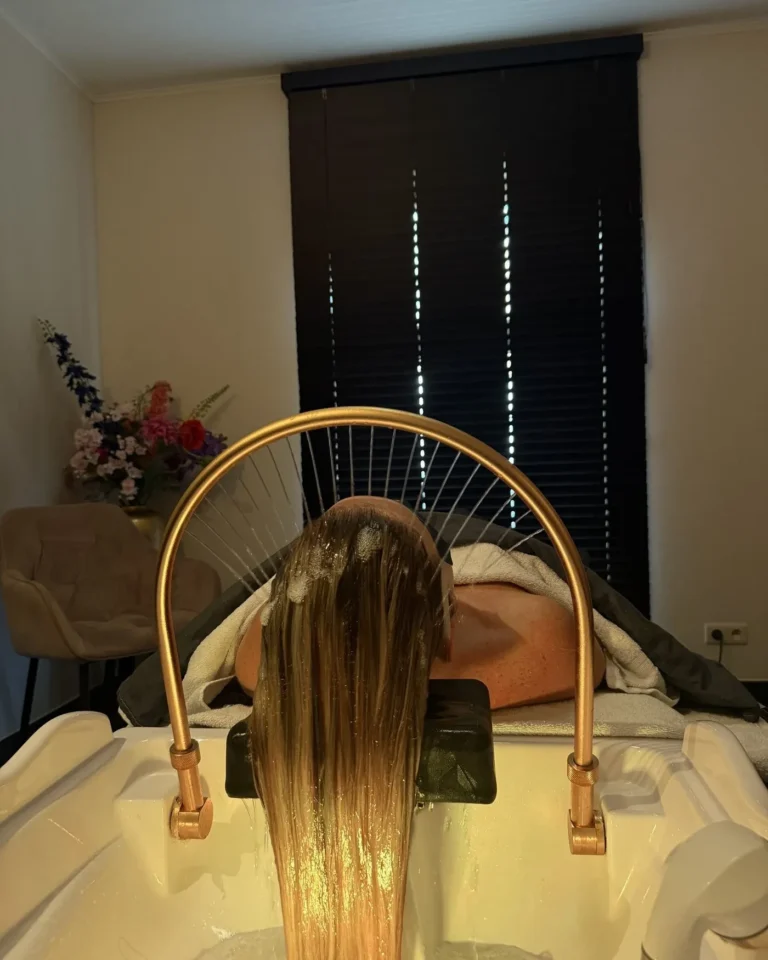
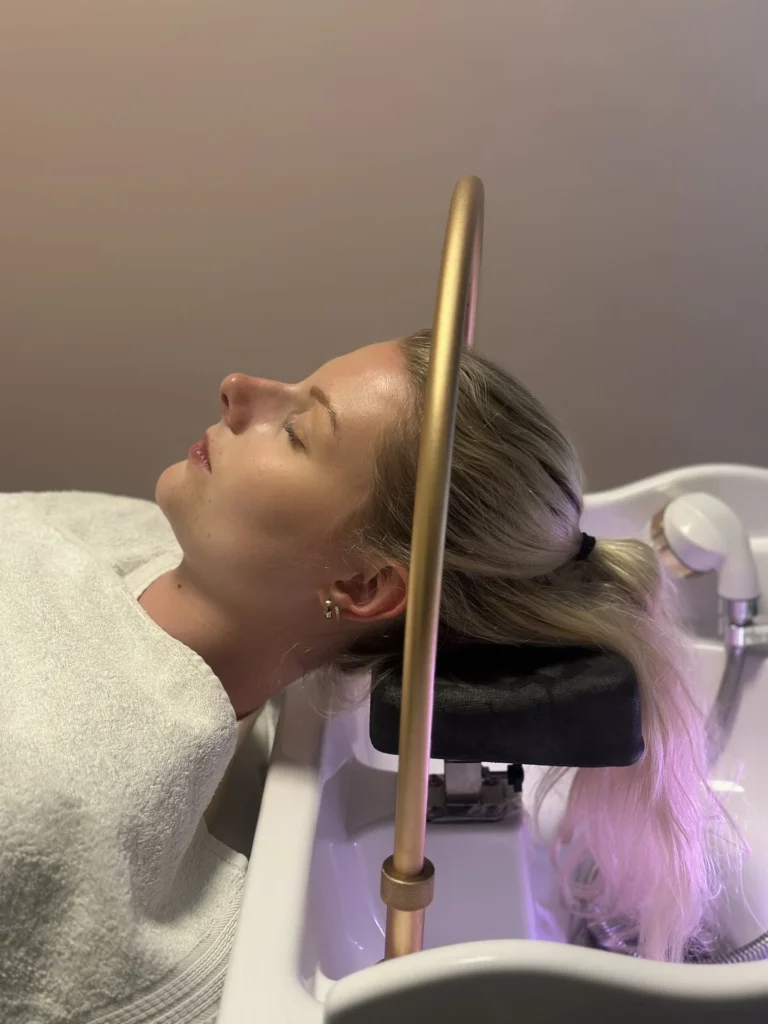
A head spa machine works on a direct water line. Cold and hot water come from the salon’s mains supply into the unit, flow out through the arch over the client’s head and leave through the basin drain. There is no pump and no heater inside the unit, so nothing electric sits in the water path.
That one design choice decides most of what follows: what plumbing you need, what can break, how you clean it and how much electricity is involved. This guide walks through each part of a Headspastore unit and what it does during a treatment.
Where does the water come from and where does it go?
Think of the unit as a very comfortable sink. The path is short:
- Mains supply. Your cold and hot water lines connect to the unit, the same way they connect to a backwash.
- The unit. Hot and cold are mixed to the temperature the therapist wants. The pressure is your building’s mains pressure; nothing inside boosts it.
- The arch. Water flows up to the arch above the basin and falls as a curtain over the scalp. The therapist decides when it runs and when it stops.
- The basin. The client’s head rests in the basin, which is shaped to catch the water around the head and neck.
- The drain. Used water leaves through the basin drain into your waste line.
Water comes in warm, does its job and goes out. It is never stored, recirculated or heated inside the unit.
Why is there no pump and no heater inside?
Some head spa units on the market pump water from a tank and heat it with an internal element. That design has a reason: it lets the unit work without a plumbed water point. It also adds two more parts that can fail, and when they fail, they fail in the water path.
A heating element that stops working means cold water, which means cancelling every head spa booked that day. A pump that weakens or seizes means a thin trickle from the arch, or nothing at all. Both are electrical, both sit in the water, and both need a technician and a spare part before you can take bookings again.
A direct-water unit has neither. Hot water comes from your building, where it is already produced for the backwash, and pressure comes from the mains. The parts that carry water are the connections, the arch and the basin: nothing that needs electricity to move water.
If something does need replacing within the 2-year warranty on normal use, spare parts are shipped from our factory partner. In practice the list of things that can go wrong is short, which is the point of the design.
What do the steam unit and the light do during a treatment?
Water is only half of the ritual. Two more elements are standard on every Headspastore model.
The steam unit with hood
The steam unit, sometimes called a fumigation unit, produces warm steam under a hood that is lowered over the client’s head. The therapist adds a few drops of essential oil, so the steam carries scent as well as warmth. During this phase the client simply rests; it is the quietest part of the hour.
In the ritual it sits between the scalp cleanse and the treatment mask. It keeps the scalp warm while the product works and fills the room with the scent you have chosen, which is a large part of what makes the treatment feel like yours.
LED colour light therapy in the basin
Each basin has LED colour light therapy built in. The therapist chooses a colour for the steam phase and the basin glows around the client’s head. It is there for atmosphere and for the sense of a complete ritual, not as a medical device, and it is one of the details that makes a head spa look like a head spa, in the room and in your photos.
What plumbing does a salon need?
Three connections, all within reach of where the unit will stand:
- A cold water feed and a hot water feed, as for a backwash.
- A drain for the waste water.
- Mains pressure from your building; there is no internal pump to compensate for a weak supply.
Installation and the water connection are done by the customer. We recommend a plumber; a handy person can do it. The catalogue PDF lists the water connections and dimensions for every model, so your plumber can prepare the point before the crate arrives.
If you are converting an existing backwash position, the feeds and the drain are usually already there. If you are building a new treatment room, plan the water point first and the furniture second: the unit should stand so the therapist can work at the head end with the arch in front of them.
What about electrics?
Because the unit does not heat or pump water, the electrical side is simple. Every model runs on 110 to 240 V and ships with the correct plug for your country, whether that is the US, the UK, Australia or the EU. All units are CE marked.
Only the models with an electric backrest or electric height adjustment need power for those functions. The Head Spa Foot Deluxe at $3,390 excl. VAT has an electric backrest and a foot bath; the Japanese Head Spa, Japanese Head Spa Pro and Head Spa Yokohama in the head spa beds category have no motor in the frame.
In short: a normal socket near the unit, and no dedicated circuit for a water heater, because there is none.
How do you clean a head spa unit?
Clean it like a sink. The basin is acrylic or ceramic depending on the model, so it takes the same wipe-down as any backwash: rinse, mild cleaner, dry. The arch is rinsed by its own water flow during every treatment.
Because there are no internal tanks, no pump lines and no heater, there is nothing hidden to descale, flush or disinfect. Water passes through once and leaves. The upholstery is vegan leather and wipes clean, and the padded cushion that turns the basin into a treatment table is cleaned the same way.
The steam unit is looked after like any other steamer in a treatment room.
Direct-water unit, pumped unit or mobile tank unit?
| Feature | Direct-water unit | Pumped unit with internal heater | Mobile tank unit |
|---|---|---|---|
| Water source | Salon’s cold and hot mains supply | Internal tank or mains, pushed by a pump | Clean-water tank you fill by hand |
| Hot water | From the building’s hot water line | Heated by an element inside the unit | Warmed inside the unit, from the tank |
| Electric parts in the water path | None | Pump and heater | Pump and heater, fed from the tank |
| Plumbing needed | Cold, hot and drain within reach | Varies by model | None |
| What stops a booking | A building-wide water problem | A failed pump or heater | Forgetting to fill or empty the tanks |
| Cleaning | Like a sink | Tank, pump lines and heater to flush and descale | Empty the waste tank daily, refresh the clean tank every few days, rinse the filter |
| Headspastore models | All head spa beds; the Head Spa Shampoo Chair also connects directly to mains water | None | Mobile Head Spa Deluxe |
What is the exception: the Mobile Head Spa Deluxe?
The Mobile Head Spa Deluxe is the one Headspastore unit that is not on a direct water line. It is a basin unit on wheels, fed from its own 60-litre clean-water tank, with a second 30-litre tank for waste water. You roll it up to your own treatment table, do the ritual, then roll it away and empty the waste tank.
It exists for rooms without a water point, for mobile work and for salons that want to run the treatment before committing to a plumbed station. Because it has to move and warm its own water, it is the one unit in our range with a pump and a heater. Light therapy is built in, it comes in White or Black, and it costs $2,290 excl. VAT.
For a permanent station we still recommend a plumbed bed such as the Japanese Head Spa Pro, our head spa bed for daily use at $1,990 excl. VAT, because the direct water line is the simpler system to live with day after day. Every unit is made to order, the beds standard in Natural Beige and Black (Head Spa Yokohama: Espresso), or any of 42 finishes, and delivered in 8 to 10 weeks, to your door for $199 per unit with import duties included; details are on the delivery and warranty page.
Quick answers
How does a head spa machine get its water?
From the salon's cold and hot mains supply. Water flows through the unit to the arch, over the scalp and out through the basin drain. It is never stored or recirculated inside the unit.
Does a head spa bed need a pump or a water heater?
Not a Headspastore one. Every head spa bed works at mains pressure and uses your building's hot water, so there are no electronics in the water path to fail.
What plumbing do I need for a head spa bed?
A cold feed, a hot feed and a drain within reach of the unit, at mains pressure. Installation is done by the customer and a plumber is recommended.
What voltage does a head spa unit use?
110 to 240 V, with the correct plug for your country included. Only models with an electric backrest or electric height adjustment need power for those functions.
How do I clean a head spa basin?
Like a sink: rinse, mild cleaner, dry. The basin is acrylic or ceramic and there are no internal tanks, pump lines or heater to flush or descale.
Is there a head spa basin that needs no plumbing?
Yes. The Mobile Head Spa Deluxe is fed from its own clean-water and waste-water tanks and rolls up to your own treatment table. It costs $2,290 excl. VAT and comes in White or Black.